




Total runs:
17.5K
Run Growth:
2.2K
Growth Rate:
12.78%
Authors (* indicates equal contribution)
Haoxiang Wang* , Wei Xiong* , Tengyang Xie , Han Zhao , Tong Zhang
Blog : https://rlhflow.github.io/posts/2024-05-29-multi-objective-reward-modeling/
Tech Report : https://arxiv.org/abs/2406.12845
Model : ArmoRM-Llama3-8B-v0.1
Architecture
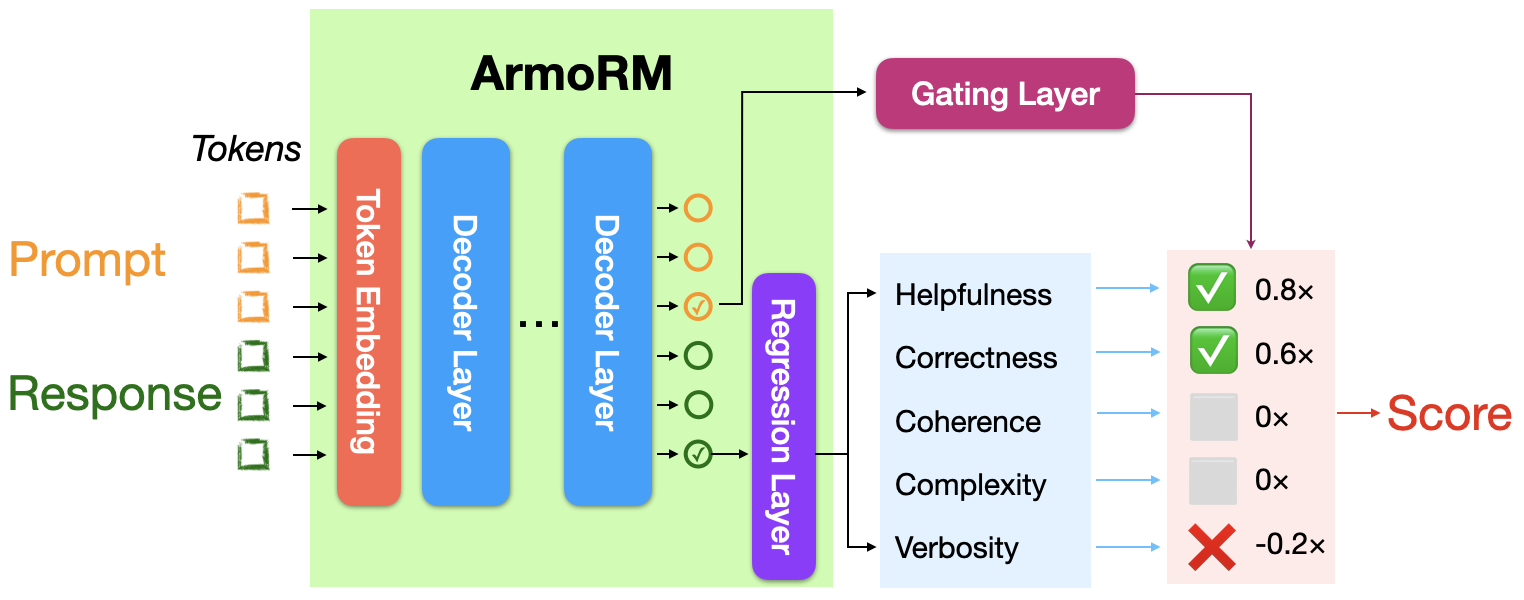
| Model | Base Model | Method | Score | Chat | Chat Hard | Safety | Reasoning | Prior Sets (0.5 weight) |
|---|---|---|---|---|---|---|---|---|
| ArmoRM-Llama3-8B-v0.1 | Llama-3 8B | ArmoRM + MoE | 89.0 | 96.9 | 76.8 | 92.2 | 97.3 | 74.3 |
| Cohere May 2024 | Unknown | Unknown | 88.3 | 96.4 | 71.3 | 92.7 | 97.7 | 78.2 |
| pair-preference-model | Llama-3 8B | SliC-HF | 85.7 | 98.3 | 65.8 | 89.7 | 94.7 | 74.6 |
| GPT-4 Turbo (0125 version) | GPT-4 Turbo | LLM-as-a-Judge | 84.3 | 95.3 | 74.3 | 87.2 | 86.9 | 70.9 |
| FsfairX-LLaMA3-RM-v0.1 | Llama-3 8B | Bradley-Terry | 83.6 | 99.4 | 65.1 | 87.8 | 86.4 | 74.9 |
| Starling-RM-34B | Yi-34B | Bradley-Terry | 81.4 | 96.9 | 57.2 | 88.2 | 88.5 | 71.4 |
import torch
from transformers import AutoModelForSequenceClassification, AutoTokenizer
device = "cuda"
path = "RLHFlow/ArmoRM-Llama3-8B-v0.1"
model = AutoModelForSequenceClassification.from_pretrained(path, device_map=device,
                               trust_remote_code=True, torch_dtype=torch.bfloat16)
tokenizer = AutoTokenizer.from_pretrained(path, use_fast=True)
# We load a random sample from the validation set of the HelpSteer dataset
prompt = 'What are some synonyms for the word "beautiful"?'
response = "Nicely, Beautifully, Handsome, Stunning, Wonderful, Gorgeous, Pretty, Stunning, Elegant"
messages = [{"role": "user", "content": prompt},
           {"role": "assistant", "content": response}]
input_ids = tokenizer.apply_chat_template(messages, return_tensors="pt").to(device)
with torch.no_grad():
   output = model(input_ids)
   # Multi-objective rewards for the response
   multi_obj_rewards = output.rewards.cpu().float()
   # The gating layer's output is conditioned on the prompt
   gating_output = output.gating_output.cpu().float()
   # The preference score for the response, aggregated from the
   # multi-objective rewards with the gating layer
   preference_score = output.score.cpu().float()
# We apply a transformation matrix to the multi-objective rewards
# before multiplying with the gating layer's output. This mainly aims
# at reducing the verbosity bias of the original reward objectives
obj_transform = model.reward_transform_matrix.data.cpu().float()
# The final coefficients assigned to each reward objective
multi_obj_coeffs = gating_output @ obj_transform.T
# The preference score is the linear combination of the multi-objective rewards with
# the multi-objective coefficients, which can be verified by the following assertion
assert torch.isclose(torch.sum(multi_obj_rewards * multi_obj_coeffs, dim=1), preference_score, atol=1e-3)
# Find the top-K reward objectives with coefficients of the highest magnitude
K = 3
top_obj_dims = torch.argsort(torch.abs(multi_obj_coeffs), dim=1, descending=True,)[:, :K]
top_obj_coeffs = torch.gather(multi_obj_coeffs, dim=1, index=top_obj_dims)

# The attributes of the 19 reward objectives
attributes = ['helpsteer-helpfulness','helpsteer-correctness','helpsteer-coherence',
   'helpsteer-complexity','helpsteer-verbosity','ultrafeedback-overall_score',
   'ultrafeedback-instruction_following', 'ultrafeedback-truthfulness',
   'ultrafeedback-honesty','ultrafeedback-helpfulness','beavertails-is_safe',
   'prometheus-score','argilla-overall_quality','argilla-judge_lm','code-complexity',
   'code-style','code-explanation','code-instruction-following','code-readability']

example_index = 0
for i in range(K):
   attribute = attributes[top_obj_dims[example_index, i].item()]
   coeff = top_obj_coeffs[example_index, i].item()
   print(f"{attribute}: {round(coeff,5)}")
# code-complexity: 0.19922
# helpsteer-verbosity: -0.10864
# ultrafeedback-instruction_following: 0.07861

# The actual rewards of this example from the HelpSteer dataset
# are [3,3,4,2,2] for the five helpsteer objectives:
# helpfulness, correctness, coherence, complexity, verbosity
# We can linearly transform our predicted rewards to the
# original reward space to compare with the ground truth
helpsteer_rewards_pred = multi_obj_rewards[0, :5] * 5 - 0.5
print(helpsteer_rewards_pred)
# [2.78125   2.859375  3.484375  1.3847656 1.296875 ]
from typing import Dict, List
import torch
from transformers import AutoModelForSequenceClassification, AutoTokenizer


class ArmoRMPipeline:
    def __init__(self, model_id, device_map="auto", torch_dtype=torch.bfloat16, truncation=True, trust_remote_code=False, max_length=4096):
        self.model = AutoModelForSequenceClassification.from_pretrained(
            model_id,
            device_map=device_map,
            trust_remote_code=trust_remote_code,
            torch_dtype=torch_dtype,
        )
        self.tokenizer = AutoTokenizer.from_pretrained(
            model_id,
            use_fast=True,
        )
        self.truncation = truncation
        self.device = self.model.device
        self.max_length = max_length

    def __call__(self, messages: List[Dict[str, str]]) -> Dict[str, float]:
        """
        messages: OpenAI chat messages to be scored
        Note: no batching since due to length differences, the model will have to pad to the max length which is not efficient
        Returns: a dictionary with the score between 0 and 1
        """
        input_ids = self.tokenizer.apply_chat_template(
            messages,
            return_tensors="pt",
            padding=True,
            truncation=self.truncation,
            max_length=self.max_length,
        ).to(self.device)
        with torch.no_grad():
            output = self.model(input_ids)
            score = output.score.float().item()
        return {"score": score}

# Create Reward Model Pipeline
prompt = 'What are some synonyms for the word "beautiful"?'
rm = ArmoRMPipeline("RLHFlow/ArmoRM-Llama3-8B-v0.1", trust_remote_code=True)
# score the messages
response1 = 'Nicely, Beautifully, Handsome, Stunning, Wonderful, Gorgeous, Pretty, Stunning, Elegant'
score1 = rm([{"role": "user", "content": prompt}, {"role": "assistant", "content": response1}])
print(score1)

response2 = '''Certainly! Here are some synonyms for the word "beautiful":

1. Gorgeous
2. Lovely
3. Stunning
4. Attractive
5. Pretty
6. Elegant
7. Exquisite
8. Handsome
9. Charming
10. Alluring
11. Radiant
12. Magnificent
13. Graceful
14. Enchanting
15. Dazzling

These synonyms can be used in various contexts to convey the idea of beauty.'''
score2 = rm([{"role": "user", "content": prompt}, {"role": "assistant", "content": response2}])
print(score2)

response3 = 'Sorry i cannot answer this.'
score3 = rm([{"role": "user", "content": prompt}, {"role": "assistant", "content": response3}])
print(score3)
If you find this work useful for your research, please consider citing:
@article{ArmoRM,
      title={Interpretable Preferences via Multi-Objective Reward Modeling and Mixture-of-Experts},
      author={Haoxiang Wang and Wei Xiong and Tengyang Xie and Han Zhao and Tong Zhang},
      journal={arXiv preprint arXiv:2406.12845},
}

@inproceedings{wang2024arithmetic,
      title={Arithmetic Control of LLMs for Diverse User Preferences: Directional Preference Alignment with Multi-Objective Rewards},
      author={Haoxiang Wang and Yong Lin and Wei Xiong and Rui Yang and Shizhe Diao and Shuang Qiu and Han Zhao and Tong Zhang},
      year={2024},
      booktitle={ACL},
}
The second entry, " Arithmetic Control of LLMs for Diverse User Preferences: Directional Preference Alignment with Multi-Objective Rewards ", is another recent work of ours that trained a multi-objective reward model and adopted it for LLM alignment, which motivated us to develop the current work.